
Tuesday, April 6, 2010

Garden Inspiration: Straw Bale Method


If you’re an urban gardener without enough space to grow even a tomato plant or two, “building” a garden with straw bales creates a new possibility. Rocky, uneven, or unyielding clay soil? Have difficulty stooping or bending to garden? With straw bales, you create the biodegradable equivalent of a raised bed. Plant a wonderful kitchen herb garden right next to your house, even on a concrete patio. Grow plants in a mud-free, weed-free medium that turns to mulch after a growing season or two. Straw Bale Gardening is simply a different type of container gardening. Put one on a balcony or a path or anywhere you have limited space.

Use one or multiple bales, arranging them in any pattern you like. The bales are raised but also be sure to allow for easy access to work in and around your garden. Wheat or oat straw is best as it's the stalks left from harvesting grain with very few seeds. Hay bales are less popular as they are made of whole plants with more seeds, and often other weeds in the mix. Use what you can get locally. You can get one good season out of a bale, sometimes two, but eventually it will decompose. Recycling into great compost or mulch when has eventually worn down is another bonus to this method!
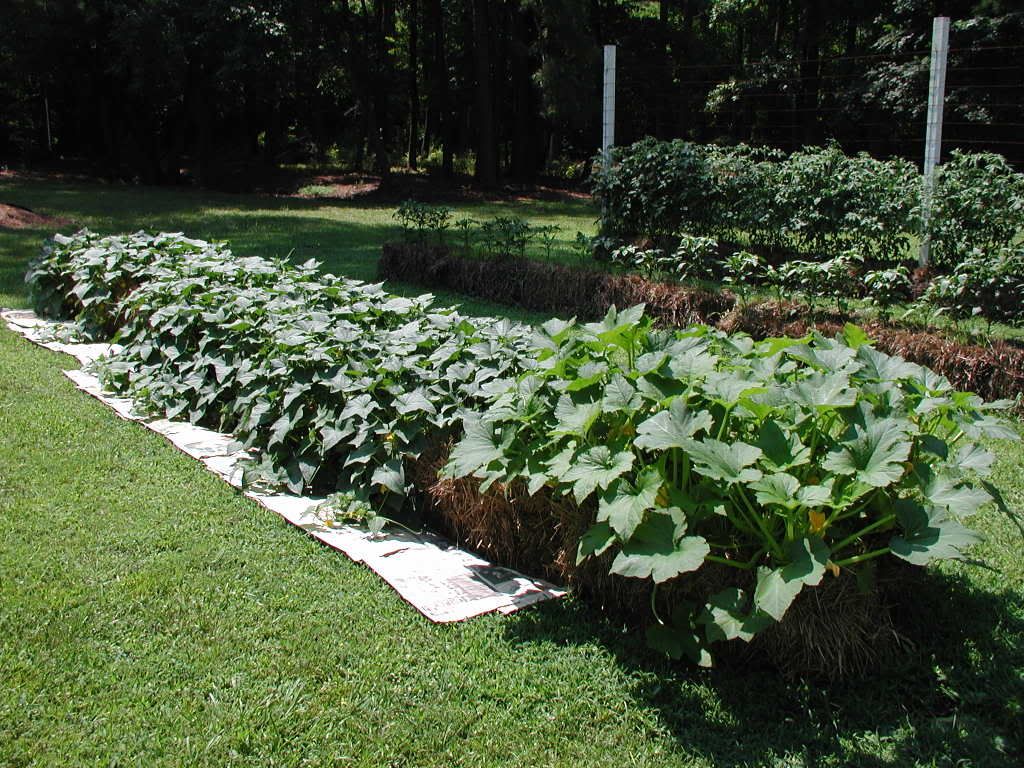

Lay them lengthwise to make planting easy by just parting the straw. Make sure the string is running around each bale and not on the side touching the ground in case it's degradable twine.Keep the twine there to hold it all in place. If it starts to rot bang some stakes in at both ends, or chock up the ends with something heavy--rocks, bricks, boxes or planted containers.

Starting off with slightly aged bales of about 6 months is best, but if they're new, thoroughly soak with water and leave for five days until the temperature rises on the inside, then cools to be ready for planting. There won't be much composting inside yet as that can take months, but an initial hot cooking is not good for your plants.

The most frequent care is keeping things watered. Straw bale gardening uses more water than a normal garden, so set up a system and stick with it. In some areas a full watering can per day is enough, in warmer, drier areas keep the garden hose handy.

Straw bale gardening — plants to plant

Annuals of vegetables, herbs or flowers all work well. Remember your bales will be decomposed in 1-2 years. Young plants can go straight in. Pull apart or use a trowel, and depending on the state of the straw, mix a handful of compost soil in; then let the straw go back into place. Seeds can be planted on top if you put a layer of compost soil there first.

Top heavy veggies like corn don't work well, unless you grow dwarf varieties. With straw bale gardening staking is difficult so tomato plants will happily dangle over the edges. Each bale should take up to half a dozen trailing cucumbers, also try squash, zucchini or melons. Four pepper plants will fit in one bale or 12-15 bean or pea plants. You can add a plant or two of flowers around the edges--trailing varieties will spill over the sides and add color.

Once every 1-2 weeks water in a liquid organic feed, such as compost tea or fish emulsion. Add some earthworms on top of the soil if you want to use your bales for only one season. Pulling out any wayward grain seeds with straw bale gardening is quick and easy. Hay bales may need an occasional haircut rather than pulling the new sprouts out.

Tuesday, August 25, 2009

Garden Inspiration: Patios


Do you have a patio? Don't all of these look very inviting?

Images via Sunset.

Thursday, July 9, 2009

Garden Inspiration: Arbors and Trellises


Saturday, May 16, 2009

Good People: Growing Gardens

Growing Gardens gets at the root of hunger right here in Portland, Oregon. The Portland Home Garden Project began in 1996. The organization's original focus was installing home gardens for low income households in Portland. The organization expanded its mission to build gardens in partnership with other organizations with the involvement of hundreds of community volunteers. The organization was renamed Growing Gardens in 1998. 


In 1999, Growing Gardens began offering workshops on topics such as basic gardening, composting, cooking and food preservation. An education and service-learning program for youth, called Youth Grow, began in 2000.

Organizing hundreds of volunteers, Growing Gardens builds organic, raised bed vegetable gardens in backyards, front yards, side yards and even on balconies. Supporting low income households for three years with seeds, plants, classes, mentors and more.  They offer Youth Grow after school garden clubs growing the next generation of veggie eaters and growers.  Through Learn & Grow workshops and work parties, they are teaching gardeners about growing, preparing and preserving healthful food while respecting the health of the environment.


Growing Gardens
 plants seeds for good food and healthy people by making sure low income people have the resources  they need to grow organic vegetables at home.  Through this work, community members meet over the backyard garden, through volunteering, by attending classes, and through sharing extra produce.


Portland Chickens!

A group of volunteers who seek to promote the joy of chickens and freedom to design and build small structures without permit requirements. The passion about Urban Chickens is for many reasons, here are a few: They bring us closer to the chain of life, they make great pets, fresh eggs, fertilizer for the garden, and they are Voracious Insect Eaters.


The Urban Chickens group has found a perfect match with non-profit Growing Gardens. Sign up for the Growing Gardens newsletter to receive information on Upcoming Portland Chicken Events.


For more info on Growing Gardens visit HERE.

Images copyright Growing Gardens & Jim Golden, 2009.

Wednesday, May 13, 2009

Garden: Grow veggies in 2-4 square feet


For anyone that loves fresh veggies but is short on space or maybe you just doesn't want the upkeep...this might be just your ticket for a mini garden this summer.  

TOMATO
In a sunny 2-foot square bed, tuck a single plant. Prolific varieties include 'Sun Gold', a cherry type, or 'Early Girl', a medium slicer. 

+ BASIL
In a 3-foot square bed, grow three basils and a tomato plant.  Perfect for making pesto and for pairing with tomatoes and mozzarella in summer salads.

+ CHIVES & CUKES
In a 4-foot square bed, add a row of chives beyond the basil, then plant a single cucumber vine.

Discovered HERE.

Thursday, April 30, 2009

Garden: Be green and lose the lawn

We live in an apartment. It's a really great apartment but we don't have a yard. Someday, if we own a house, we'd like it to have a yard. Most people think that a yard means grass. Must. Have. A. Lawn. My question is WHY?


I remember my Dad doing battle with 'THE LAWN' for years. Mowing, edging, fertilizing, moss and weed control, watering...in short, a lot of maintenance. He said more than once if he had it to do over, he'd remove all the grass and create a simple landscape with rock, stone and low-care grasses.

The more I read about eco-friendly alternatives to the American tradition of the lush, green lawn, the more I am excited about those other possibilities and I believe that my Dad was ahead of his time with his landscape ideas.


Water-conserving gardens can be as colorful as any other. The front yard of Rick Cole, Ventura's city manager, is blooming proof. How pretty is that?!


Flagstone paths curve through a low-water front yard. A low berm of soil on either side of the walk adds interest, and weed cloth topped with permeable pea gravel allows excess water to soak into the earth rather than run off into the street.


Lawns need an inch of water each week during the growing season. Seattle-based landscape designer Stacie Crooks of Crooks Garden Design, knew she could create a beautiful tapestry of plants that would survive on half the water. She removed most of her lawn and planted a mix of perennials and shrubs.


Plant natives, and birds will follow. Designer and contractor Greg Rubin ― who specializes in California natives ― removed this lawn and created a curving path bordered by fragrant 'Bee's Bliss' salvia, wild lilacs, and an existing non-native purple tree mallow ― all are pretty, low-water plants.


Landscape designer Shirley Watts is on a mission to green up her gardens. Instead of packing them with foliage she found green solutions that benefit the environment by preserving resources and by recycling materials.


Style and practicality determined the design of this water-conserving garden in Clovis, California. In many areas of the West, water is a precious and limited commodity requiring careful management.


1. Do you have a lawn? Do you love it?
2. How do you deal with your lawn in a drought?
3. If you don’t have a lawn, what do you have instead?

Find more inspiring eco-yard photos, tips and ideas HERE.

Saturday, April 11, 2009

Neat Things: Garden Gnomes


You know, something for the neighborhood kids to steal...

...get yours at the first link below.

Found HERE via HERE.

Friday, April 10, 2009

Garden Inspiration: Fire and Fountain

The designers of this space organized the yard into zones that correspond to the home's interior rooms: large patios for group activities, intimate ones for relaxing. A redwood boardwalk, fringed with pink-flowered coral bells, connects a bedroom deck and breakfast nook with the main bluestone patio and dining area on the garden's opposite side.

How divine...*sigh*


FOUND HERE.

Friday, April 3, 2009

Garden Inspiration: Planter Boxes

Besides bringing natural beauty to our living spaces, plants create texture and balance, a room or patio can be transformed into an environment that comforts and welcomes. Plants do much more than look pretty--they’ve been proven to reduce stress so well that one glance at a plant lowers your heart rate. They clean the air we breathe by absorbing toxins and act as little oxygen factories. Plants simply make us feel better!


Studies show that:
1. In addition to calming your heart rate, plants lower blood pressure and reduce muscle tension related to stress.


2. Plants help us relax and focus, leading to increased productivity,creativity, idea generation, and problem solving capabilities. The presence of plants helps so much that it has been shown to relieve the symptoms experienced by children with ADD.


3. Plants help patients recovering from surgery and ease the symptoms of Alzheimer’s.


We are beginning to learn what our ancestors knew for centuries, plants are more than just ornaments. Simple cohabitation with them brings us health and calm.

Tuesday, March 31, 2009

DIY Project: Wood Storage Cubbies

Nursery pots and planting paraphernalia stay put in these cleverly constructed garden shelves. The up slanted edges of the shelves were inspired by nesting boxes in chicken coops. So clever and space saving!


The DIY project instructions for this can be found here.

Monday, March 30, 2009

Garden Inspiration: Painted Branch

Paint a branch with vivid color to set a mood. This curvy sculpture was an Atlas cedar, painted by the garden’s owners. The designer calls it a "happy surprise that adds a punch of color to the soothing green palette." I like it, do you?


FOUND HERE.

Friday, March 27, 2009

Garden Inspiration: Urn Table

Root succulents in an 18-inch-diameter urn filled to 6 1/2 inches below the rim with potting soil, topped with a 24-inch round of tempered glass ― sold as a tabletop ― on the rim. This mini-greenhouse can double as a table for a lightly shaded patio. To keep condensation from building up on the underside of the glass, remove the glass tabletop every few days for an hour or so. Once the succulents are rooted (about four weeks), transfer them to pots or garden beds and fill the table with glass balls, shells, or your choice of decoration.


FOUND HERE.

Tuesday, March 17, 2009

Garden Inspiration: Garden Swings

Fletcher & Myburgh met in 1999 and soon shared a passion for art and nature and ultimately a vision to create functional metal work that people could interact with. Caroline's previous collection for Liberty, Steve's background in sculpture, and a Princes Trust loan heralded the start of Fletcher & Myburgh.


Lily Swing - copper & stainless steel

Six years on their working relationship has been instrumental in the conceptual and practical realisation of the company, with Stephen focusing on the design and production and Caroline active in the creative development direction.


Bubble Swing - stainless steel

While not juggling with engineering feats, drawing boards, sourcing antique metals and upping tools they live, work and create with their three children in Hampshire.


Ostara Swing - copper

Both artists have been led by their desire for a natural and organic lifestyle and by choosing precious recycled metals they have achieved just this. By drawing inspiration from the terrains in which they both grew up, South Africa and Surrey… rolling hills and curving lanes, heat and sunshine, the passion for form is evident. The result is chic pieces of copper and fire that work with all the elements, come rain or shine.


Moon Swing and copper screens - copper

So wishing I had a garden!

FOUND HERE.

Wednesday, March 11, 2009

Garden Inspiration: Field of Lights

Field of Light was originally conceived fifteen years ago, when Bruce Munro took a trip through central Australia. The red desert had an incredible feeling of energy; ideas seemed to radiate from it along with the heat. The field of light installation was one idea that landed in Bruce’s sketch book and refused to dislodge from his mind.


Field of Light can be seen at the Eden Project in Cornwall from 1st November 2008 - 31st March 2009. Bruce Munro and five assistants worked over three days to install it on the grass roof of the visitor’s centre, between the Rainforest and Mediterranean Biomes.


It is made of 6,000 acrylic stems, through which fibre optic cables run, each crowned with a clear glass sphere. There are 11 external projectors; the stems themselves hold no electric power at all. The installation covers an area of 60 x 20 meters, using 24, 000 meters of fibre optic cable. It’s best viewed after dark.


Field of Light has also been exhibited at the Victoria & Albert Museum of Art and Design in London, and under the shadow of an ancient hill in southwest England, in a field of clover bisected by a public footpath.

Visit the field of light website HERE.

Wednesday, July 23, 2008

All the flowers of summertime

"There is peace with a garden, a peace so deep and calm. That when the heart is troubled, it’s like a soothing balm. There’s life within a garden, a life that still goes on. Filling the empty places, when older plants have gone. There’s glory in the garden, at every time of year, spring, summer, autumn, winter, it fills the heart with cheer."

We live in a really great apartment. One bed, one bath, secure entry, only 4 units in our building, almost 1,000 square feet each, 3 walk-in closets, hardwood floors, huge windows facing west, garage, basement storage and a deck.

Our deck is our backyard. We live on the top floor of our building overlooking our neighborhood and we have a superb view of the west hills and the city. Portland hosts firework displays 5 times annually so we enjoy those shows for free--plus the bonus of fantastic sunsets in every season.
We've lived here going on five years and each summer we look forward to creating a new garden to enjoy. Our challenge is the hunt for a variety of plants that enjoy a full day in the sunshine. This summer we discovered a small rural nursery (in business since 1913!) on our weekly drive to attend church service. We decided to patronize their operation for our gardening needs instead of one of the big box stores. I am happy to report that the quality of the plants and the customer service is better than any retail outlet we've purchased from in the past.

We have more pots and more plants than in years past and we splurged on the flowers. I've been practicing with the macro settings on our cameras as the flowers put on their show...I hope you enjoy the results!

Visit my Etsy shop for photographs of flowers on sale now!

copyright pfeiffer photos 2008 - all rights reserved.

Friday, July 18, 2008

Our Winning Photo!


We just found out one of our images was chosen as the winner of the photo contest hosted by Lyndsey, owner of tanybug, on her fun blog, Inspired by Hand!


(Poppies by Tina Pfeiffer, Pfeiffer Photos 2007)

As our prize we will receive one of Lyndsey's handmade camera straps--we chose this fun striped one:

(Photo and handmade camera strap by tanybug 2008)


To view all the entries for the photo contest (and an archive of super articles) please visit the Inspired by Hand blog HERE. Our thanks to all the participants for their kind comments about our photo posted on the Inspired by Hand blog, and especially to Lyndsey for hosting the contest and choosing Poppies as the winner!

Have a wonderful weekend everyone!